
Recognize Gibson County Deed Records
Gibson County deed records cover more than simple sales. The Recorder's official fee sheet lists conveyances, mortgages, assignments, releases, real-estate contracts, powers of attorney, plats, and surveys. Affidavits, bonds, and planned developments appear there too. Federal tax liens, mechanic's liens, sewer liens, and assumed business names sit in the index too. UCC filings sit there as well. The document type tells you what each record actually does.
| Recorded type | What it does | Common title clue |
|---|---|---|
| Deed | Conveys the interest stated in the instrument | Names grantor, grantee, and land description |
| Executor or administrator deed | Conveys through an estate representative | Points back to probate authority |
| Mortgage or release | Creates or releases a recorded security interest | Explains an encumbrance, not ownership by itself |
| Plat or survey | Records mapped land or boundary work | Connects addition, lot, block, or tract text |
| Lien or assignment | Records a claim or transfer of a recorded interest | Requires a later release or related instrument check |
A recorded deed proves the instrument was accepted and filed. It does not prove good title by itself. Other claims may still exist, so read any releases, assignments, plats, and court records touching the same parcel.
Search Gibson County Deeds in Tapestry
For occasional deed records research, the Fidlar Tapestry portal works on a pay-as-you-go basis. The county's service sheet describes access around the clock. Each index or image search runs $8.75. Image viewing is included, and printed pages cost $1. Preparation saves money. So gather the parcel number, legal description, current owner, and likely recording period before you submit a query.
| Search field | Useful entry | Record-reading note |
|---|---|---|
| Grantor | Person or entity that conveyed | Try surnames, initials, and entity variants. |
| Grantee | Person or entity that received | Start with the current assessment owner. |
| Recording dates | Beginning and ending dates | Use recording date, not an assumed closing date. |
| Legal or parcel | Subdivision, Parcel ID, or metes-and-bounds term | Availability depends on what Gibson indexed. |
| Document type | Deed, release, lien, plat, or another verified class | Use only when the instrument class is known. |
The Recorder does not state how far back the online index reaches. Do not assume it covers the county's earliest deed book.
Compare Gibson County Deed Search Plans
Gibson County gives researchers two Fidlar options. Tapestry fits a handful of searches and accepts Visa or MasterCard per query. Laredo serves frequent users with a courthouse-style record environment, real-time access, and customizable result screens. The Recorder supplies credentials, and users install Laredo Desktop.
Laredo monthly tiers run $50 for up to 250 minutes, $100 for 251 to 1,000 minutes, $200 for 1,001 to 3,000 minutes, and $250 for unlimited use. Overage rates apply to the first three tiers. Remote printing costs $1 per page. Estimate how often you will search the deed index, then pick occasional or subscription access.
The Tapestry entry point named by the Recorder appears in the image below. Visit the official land-records service before searching.
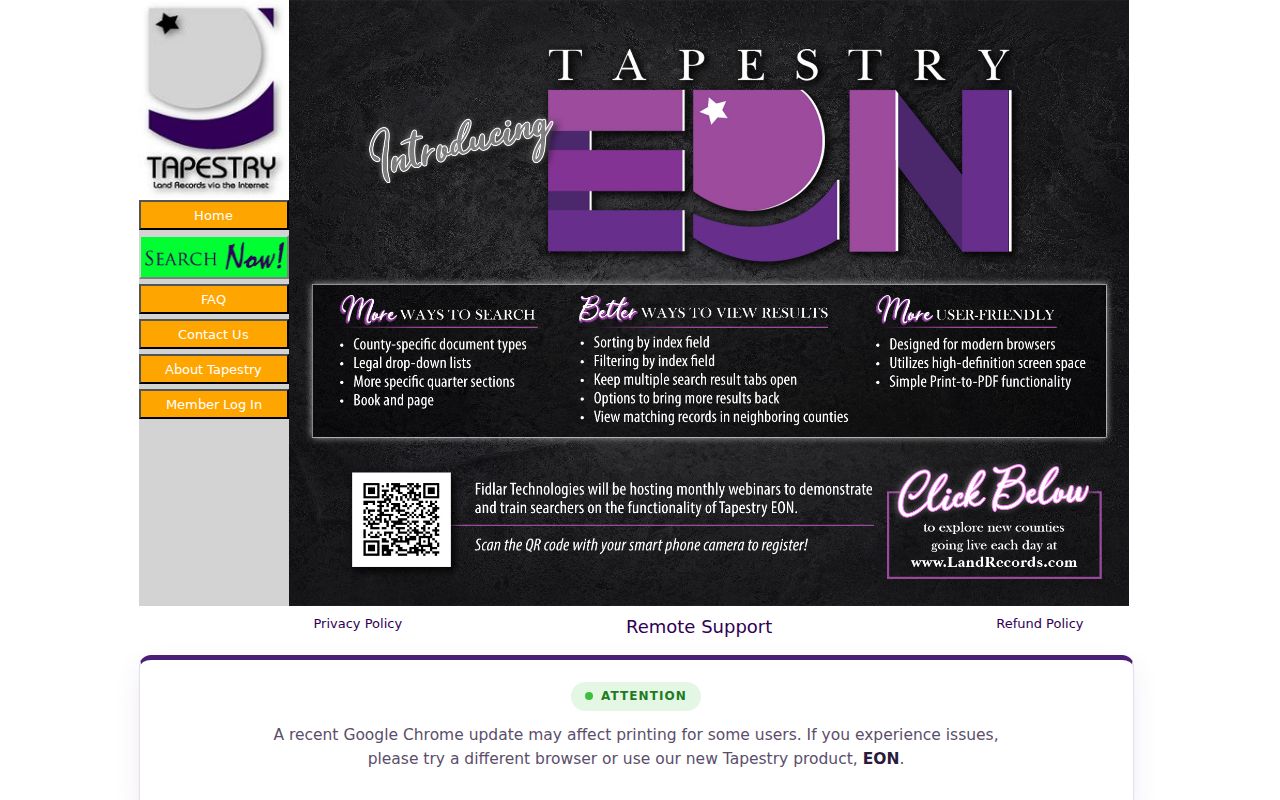
The jurisdiction must be chosen before county-specific results appear. The landing screen alone is not a Gibson County result.
Follow Gibson County Deed Index Parties
A chain of title is the ordered set of conveyances for one piece of land. To work Gibson County deed records backward, turn each prior grantor into the next grantee search. Keep the legal description beside the names, since people may own several parcels and spellings vary.
- Use the Assessor record to identify the present owner, full parcel key, and legal description.
- Search that owner as grantee and locate the newest conveyance that matches the land.
- Read the deed's grantor, recording date, legal description, and instrument or book/page reference.
- Search that grantor as a grantee in the preceding period. Repeat until the online chain ends.
- Move to courthouse indexes, old deed books, library holdings, or film when no earlier online match appears.
- Grantor
- The party conveying the interest described in the document.
- Grantee
- The party receiving that stated interest.
- Chain of title
- The linked sequence of recorded transfers for the same land.
- Instrument or book/page
- The Recorder reference used to retrieve the exact recorded document.
Pass Three Gibson County Deed Desks
Gibson County follows a local deed-processing sequence. A real-estate transfer starts with the Assessor. It then moves to the Auditor for endorsement. The sequence ends at the Recorder, and deeds cannot be processed after 3 p.m. Copies must be made and paid for by 3:45 p.m. Regular hours are 8 a.m. to 4 p.m. on weekdays.
Recorded instruments also face format rules. A conveyance needs the preparer's name, the grantee's physical address, printed names below signatures, required margins, a minimum font size, and a proper Indiana notarial block. It also needs an affirmation that reasonable care was taken to redact Social Security numbers. These requirements concern recordability. Recorder staff do not draft documents, give legal advice, or run title searches.
Read Gibson Deed Map References
Deed records often lean on a map or a related land instrument. Plats, surveys, planned developments, powers of attorney, leases, releases, and easements all appear among the Recorder's indexed classes. Historic local descriptions may cite an addition, inlot, outlot, block, lot, section, or metes-and-bounds tract. They may use these instead of a street address.
Princeton's 1814 plan left a lasting inlot and outlot vocabulary. Fort Branch ordinances record street and alley vacations in named additions. One Holcomb Addition action kept utility-related rights and identified affected lots. That is why a modern polygon or road edge may miss the legal story. Match the deed text against the recorded plat and any vacation instrument.
Extend Gibson County Deeds Beyond Online
How far back do Gibson County deed records reach online? The Recorder publishes no starting year for its Tapestry or Laredo indexes. Treat that as a real limit. Guessing at coverage only wastes an afternoon. The Princeton Public Library holds deed books covering 1813 through 1885. The Indiana State Library's county guide points to microfilm plus land-record finding aids. FamilySearch also references older land records reaching into the nineteenth century.
Once you hit the oldest usable book or instrument number online, stop there. Ask Recorder staff where the earlier index continues. The library's deed books, the State Library guide, the FamilySearch catalog, and Indiana Memory maps each carry a piece of the older chain. One caution applies. Catalog metadata can stay public while images stay restricted. Coverage in a printed book proves nothing about online searchability for the same year.
Note: No official source states an imaging cutover year or any Gibson courthouse records-loss event.
Handle Gibson Estate Deeds
A clean grantor-to-grantee chain rarely survives an estate untouched. Death, trusts, survivorship rights, and probate administration all move real estate outside the normal sale path. When a Gibson County deed lists an executor, administrator, heir, trust, or surviving spouse, search the Gibson County Clerk under the decedent or estate name. The probate file may hold wills, inventories, letters, final accounts, reports of distribution, and court orders. These papers can clarify who gained authority over the parcel.
Take every name from that file back to the Recorder. Search the executor, the trust, and the eventual grantee alike. Match the legal land description rather than trusting a shared surname. Treasurer records can help you locate the parcel. But the tax roll only shows who pays the bill. It never proves who holds title.
Use Gibson's Fraud Alert
The Recorder offers a free-standing guard against forged filings. The Gibson County Property Fraud Alert sends a notice whenever a newly recorded document matches a registered name. You can register a personal or business name. It works only after recording. The alert does not block any filing, and it is not title insurance. If a notice arrives, contact the Recorder directly. Cite the document number, and pull the recorded image to judge it yourself.
The alert page confirms the program runs locally. The Recorder stays the custodian who can verify any suspicious instrument.
Order a Gibson County Deed
Online images work well for quick reference. For the official version, order a plain or certified copy straight from the Recorder. Gibson County charges $1 per page up to 11 by 17 inches. Larger pages cost $5 each, and certification adds $5 per document. Military discharge copies are free. The Recorder sits in the courthouse at 101 N Main Street in Princeton. The office answers at 812-385-3332.
Give the office enough detail to isolate one record. Helpful items include the grantor, the grantee, and the recording date. Add the document type, the parcel or legal description, and any book, page, or instrument reference. Indiana APRA also guarantees inspection and copying during regular agency hours, subject to exemptions. For a wider sweep before ordering, try the Gibson County property search.
State plainly whether you want a plain or certified copy. A plain image fits early deed research. Certification authenticates the office copy for formal use. Large-format pages raise the total. Ask staff to confirm size and cost before sending payment. The counter and mail route also matter when Tapestry skips the older deed index. It also matters when an image is illegible, or when the exact reference remains unclear.
Recorded, not guaranteed. Gibson County deed records show filed instruments, but they are not a title opinion and cannot rule out an unrecorded interest.