
Fields Inside Gibson County Property Tax Records
A Gibson County tax inquiry pulls on three linked records. The Assessor identifies each parcel and sets its appraisal. The Auditor keeps the annual tax duplicate, along with deductions that lower the assessed value. The Treasurer then collects the bill itself. One thread ties them all together. The parcel number joins every office's property records. It still works even when a mailing address or street label has changed over the years. Start any property search with that number. The rest of the lookup then falls into place.
| Record field | Meaning in the file | Official source |
|---|---|---|
| Land, improvement, total | Components and total for a dated assessment year | Assessor parcel card |
| Assessment history | Annual values and reasons for change | Assessor parcel report |
| Deductions | Adjustments maintained for the tax duplicate | Auditor |
| District and parcel IDs | Taxing district, state parcel, and local identifier | Assessor and tax list |
| Bill and payment status | Installments, balance, payment, or delinquency | Treasurer |
An assessed total is built for taxation, not a stand-in for a fresh sale appraisal. A transfer price may still surface in the parcel history. Meanwhile the bill folds in deductions and rates for its own payable year. Keep every figure labeled. These numbers are not interchangeable. Treating them that way is the fastest way to misread Gibson County property tax records.
Three Gibson County Offices Divide the Tax Work
Questions get answered fastest at the right desk. The Gibson County Assessor handles appraisal, cyclical review, Form 11 notices, sales disclosures, and assessment appeals. The Auditor keeps the tax duplicate, deductions, address changes, transfers, and the July 1 delinquent real-estate compilation. For balances, collections, payment routes, and receipts, the Gibson County Treasurer is the office to call.
Assessor
101 N Main St., Princeton
812-385-5286
Weekdays, 8 a.m. to 4 p.m.
Auditor
Ask about the annual duplicate, deductions, address records, transfers, and delinquent-list preparation.
Treasurer
101 N Main St., Princeton
812-385-2540
Closed 11:15 a.m. to 12:30 p.m.
A recorded deed travels its own Assessor-to-Auditor-to-Recorder route. That paper trail is separate from the question of payment. It does not tell you whether a tax installment has been paid. Mixing the two sends a payment question to the wrong office. Note: The Treasurer answers payment questions. The Assessor answers value questions. The Auditor handles deductions and the tax duplicate.
Search Gibson County Property Tax Records by Real Fields
The county tax list accepts several search keys. It also shows enough context to tell similar results apart. Enter too much, though, and the result set shrinks to nothing useful. The county's own instructions make that warning. A parcel may have been split or combined within the past two years. In that case, the Treasurer recommends searching by last name to surface every bill.
| Control | Input | Best use |
|---|---|---|
| Dist# | Tax district | Narrow a local district |
| Parcel # | Full identifier | Match one tax parcel |
| Name | Owner name | Find related split or combined bills |
| Tax Year | Dropdown | Choose the bill year |
| Property Address | Address with city | Find a known site |
| Actions | Search, Next, Back, Clear, maximum results | Manage the list |
Each row displays district, parcel number, alternate identifier, owner name, and property address. The page carries a not-for-official-use notice and an update date. Confirm any consequential balance with the Treasurer before relying on it.
Follow a Gibson County Tax Bill From Address to Receipt
Start with one strong identifier. An exact parcel number works best. An address or an owner surname can also establish it. From there, Gibson County offers online viewing, electronic payment, a courthouse kiosk, mail, a drop box, and counter service, so a failed web search never ends the inquiry.
- Use the tax list or LOWtaxinfo route linked by the Treasurer and search the address, owner surname, or parcel.
- Copy the full 18-digit parcel and verify the district and situs address.
- Compare the bill with the Assessor card and Auditor deduction records for the same period.
- Choose the online or phone route, kiosk, mail, drop box, or counter, then retain the receipt.
- Assessed value
- The Assessor's value for tax administration, dated to an assessment year.
- Tax levy
- Taxes imposed through the applicable taxing units and reflected in the bill.
- Homestead deduction
- A deduction in county records that can change taxable amounts.
- Tax lien
- A claim arising from unpaid property tax, distinct from a normal current bill.
GovTech online and phone payment both require the full parcel number. The county states a 2.50 percent card fee plus a $1.50 transaction charge, with a $2 e-check charge. In the courthouse basement, the kiosk can search a balance, take payment, and print a receipt.
Gibson County Property Tax Installments and Status
The Treasurer publishes spring and fall due dates each year. Mailed payments follow the postmark rule. Check the current Treasurer notice before paying, since installment dates can shift from year to year.
| Channel | County route |
|---|---|
| Online or phone | GovTech card or e-check route with the parcel |
| Kiosk | Balance search, payment, and printed receipt |
| Counter | Cash, card, e-check, personal check, or money order |
| Coupons; stamped return envelope for a receipt | |
| Drop box | Northeast courthouse box, checks only |
Card and e-check convenience fees apply to the stated electronic routes. A reader who only wants to inspect the bill should keep that task separate from paying. Verify the year shown on screen first.
Gibson County Enters a New Reassessment Cadence
The Indiana Department of Local Government Finance reports a new reassessment cadence. The cycle began July 1, 2026 for 2026 Pay 2027 taxes. Over the next four years, assessors will inspect roughly 25 percent of parcels annually. The date on a Gibson County card is essential context. The prior county schedule ran 2023 through 2027. It split residential or agricultural review areas from commercial, industrial, and exempt areas. In 2025, Washington and Patoka townships were slated for residential review. Meanwhile, Union, White River, and Patoka were set for commercial or industrial review. For deeper context, turn to the DLGF Gibson County page. It publishes budget orders, ratio studies, approvals, and land orders. Those documents explain annual trends and neighborhood factors. They should not turn one parcel result into a countywide rule.
Form 11 Starts a Gibson County Assessment Review
Form 11 is the official notice of assessment of land and improvements. Match its parcel and assessment date against the property record card. Also check the land value, improvement value, and total. That comparison comes before any decision about a correction or appeal. The official DLGF Form 11 guidance is pictured below.
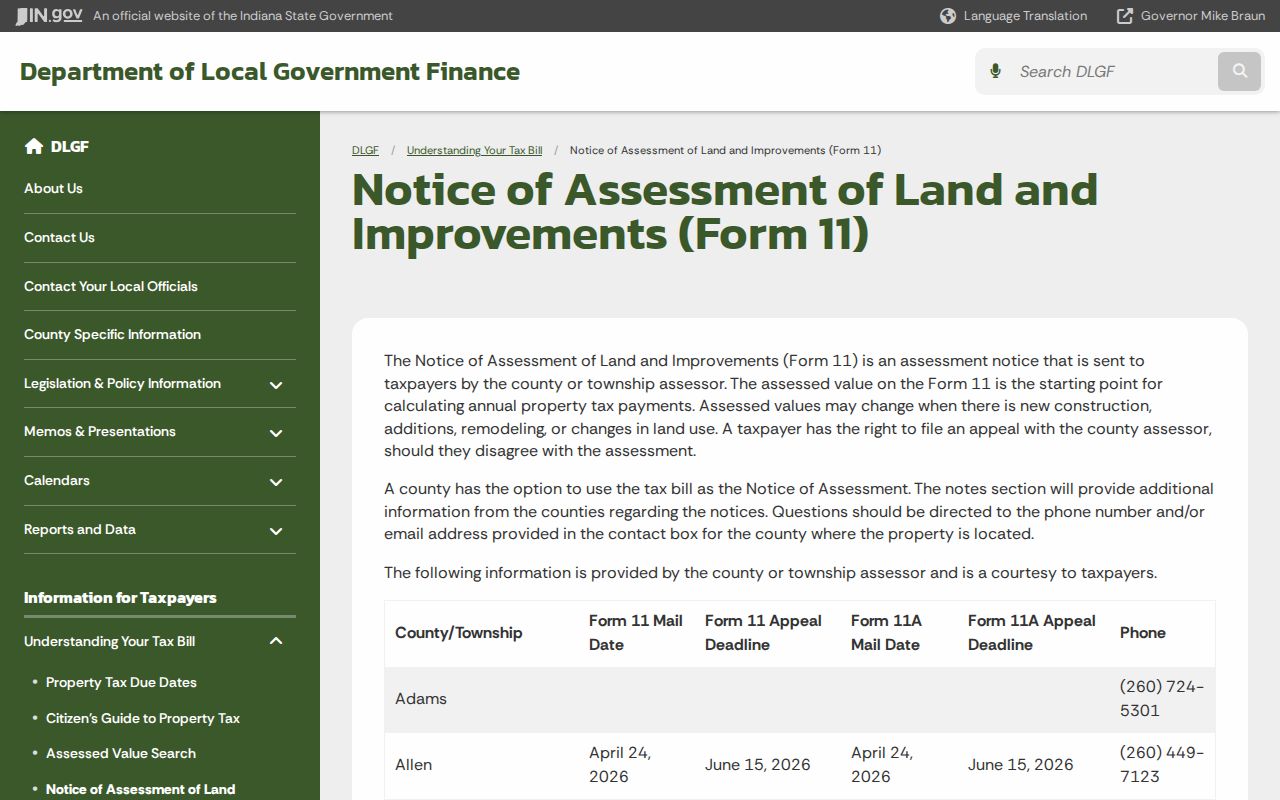
The image shows the state notice route, not a parcel-specific assessment. Rely on the current notice and its stated filing date.
Contest a Gibson County Property Tax Assessment
Line up the Form 11 and parcel card against objective facts. Land size, structure traits, and class belong in that comparison. Legal description and dated value history belong there too. The Assessor owns the value question. The Assessor works with the Property Tax Assessment Board of Appeals. The other tax offices cannot change appraisal facts just because they maintain deductions or payments.
Protect the filing window. Use the deadline on the current Form 11 or DLGF Gibson posting. Research captured a June 15, 2027 listing, but another notice or year may have a different controlling date.
Submit the prescribed form with parcel-specific evidence. Dated photos, measurements, recorded descriptions, and comparable record evidence carry weight. Proof of an incorrect class or feature does too. A broad claim that the bill feels high does not. Keep a copy of the filing and the board notice for your records.
Delinquent Gibson County Property Tax and Tax Sales
Gibson County handles delinquency through two offices. The Auditor builds the delinquent real-estate list by July 1. The Treasurer handles balances and payment questions. A separate annual notice names the parcels facing sale under Indiana Code 6-1.1-24. The 2024 notice described an October online sale.
Parcels sold there carry a right of redemption. The minimum bid covered delinquent taxes, special assessments, current-year taxes, penalties, and set costs. Each year brings new dates, lists, and registration rules. Verify them annually.
A sale certificate is not finished title. Redemption and later court or deed steps still apply. Also note that a mortgage foreclosure runs through Sheriff and court records, a different path from the Treasurer's tax sale. Keep the two separate even at one address.
Verify Gibson County Property Tax Results With the Custodian
Each online tool has its own job. The tax list locates the row. LOWtaxinfo shows the bill. Payment routes move the money. None of them settles a timing dispute or a returned payment. None of them handles a split parcel or a pending sale. That takes the custodian. For appraisal and property card questions, the Gibson County Assessor page is the place to start.

The Treasurer's office page names the custodian and the contact route. Use it to confirm. A sample value is never a certified tax statement. The Gibson County Treasurer page appears below.

Current notices and payment options on that page finish the inquiry once the parcel and year are matched.
Date Every Gibson County Assessment and Tax Figure
Dates matter with every Gibson County tax figure. The official sample parcel report shows why. It spans assessment history from 2020 through 2025, with as-of dates, value entries, and reasons for each change. Transfer dates, sale prices, deed references, parcel characteristics, and a sketch appear too. A tax list row carries its own tax year. Capture each label beside its number.
Assessment year and payable year are related but distinct. A recent transfer can reach the Recorder before an assessment update lands. A payment can post after a list was generated. When figures clash, call the office that owns the field: the Assessor for value, the Auditor for duplicate and deduction data, or the Treasurer for balance and receipt status.
Indiana APRA, Code 5-14-3, guarantees inspection and copying of disclosable records during regular hours. A request should name the parcel, record type, and year with reasonable particularity. An agency need not build a custom analysis. Still, a counter or written request works when no portal can answer the question.