
Start a Gibson County Property Search
Start with the clue you already have. An address or an owner name fits the county-linked Beacon search, and a parcel number works there too. Beacon advertises lookups by name, address, or parcel. One result can orient everything at once. The listing may show the owner of record, the situs location, a mailing address, the legal description, assessment figures, and recent transfer data. Filter labels can shift, so read them as they appear when the portal opens. A parcel number is the strongest bridge between Beacon and the other desks.
No single database holds the whole file. The Recorder keeps the deeds and other recorded instruments. The Treasurer handles the bills and payments. The Auditor maintains the tax duplicate, deductions, transfers, and delinquency material. GIS adds the map context, so carry the same parcel key and legal description to every stop.
- Search the Beacon property host by address, name, or parcel number.
- Save the full parcel number and legal description from the matching record.
- Check the current deed and related instruments through the Recorder's land-record route.
- Compare the tax account and map position without treating either as proof of title.
- Request a certified copy from the custodian when the record must support a formal decision.
An online result is an aid, not a certified record. Date each search, because assessment, payment, and ownership systems can update on different schedules.
Gibson County Records Desks
The courthouse at 101 N Main Street in Princeton holds the central property-record offices. The Recorder preserves deeds, mortgages, liens, plats, surveys, leases, and releases. The Assessor tracks parcel traits and values. The Treasurer handles billing and payments. All three open weekdays from 8 a.m. to 4 p.m. Deed processing stops earlier.
Gibson Deeds Cross Three Desks
Gibson County runs deeds through three desks in order. A deed presented for recording starts at the Assessor. It then passes to the Auditor. The Recorder finishes the sequence, and the handoff ties the transfer to the parcel, the tax duplicate, and the recorded instrument. Deed processing stops at 3 p.m. even though the offices list later closing hours. The Recorder's copy and payment window ends at 3:45 p.m.
That order explains why systems lag after a closing. A newly recorded deed may outrun the owner name on an assessment screen. A tax mailing name is no substitute for the deed. Check grantee, legal description, parcel, and recording date. Only then decide that two entries describe the same Gibson County property.
Note: Call the Recorder before a time-sensitive visit because the published deed-processing cutoff is earlier than the general office closing time.
Gibson Parcel Numbers Connect Records
Gibson County documents show long state parcel numbers such as 26-12-18-103-000.403-028. Keep every digit, dash, and decimal point. A parcel number, or APN, is the tax and mapping identifier for a tract. Shorter local IDs appear alongside the state form. The county publishes no key to every segment, though the leading code and trailing district work as cross-checks. Numbers can also change after a split or combination.
- Parcel number
- The key used to match assessment, tax, and map records.
- Situs address
- The physical location used in the property record.
- Legal description
- The deed identity, often stated by lot and block or by section and bounds.
- Plat
- A recorded drawing that lays out lots, streets, and related land features.
Splits and combinations complicate things. The Treasurer advises a last-name search when a parcel changed within the prior two years. Old deeds may still carry the prior key. Then the legal description and transfer chain matter more than the street line alone.
Gibson County Property Record Types
Every Gibson County property record answers a narrow question. Deeds document conveyances, assessment files describe taxable parcels, and tax accounts show charges and payments. Plats and GIS place the land on a map. Court files can surface a foreclosure, quiet-title dispute, probate transfer, or lien enforcement, though MyCase is not the official court record.
| Record Type | What It Documents | Kept By | Access |
|---|---|---|---|
| Deeds | Transfers, parties, dates, and legal descriptions | Recorder | Tapestry, Laredo, or courthouse |
| Mortgages and liens | Recorded debt and releases | Recorder | Land-record index and copies |
| Assessment and tax | Values, deductions, bills, and balances | Assessor, Auditor, Treasurer | Beacon, tax list, or office |
| Plats and parcels | Lots, map context, roads, and districts | Recorder, GIS, Surveyor | Viewer, downloads, maps, copies |
| Permits | Project, zoning, and inspection clues | City, town, or state office | Forms and records requests |
A transfer or lien calls for the recorded instrument. An assessment card beats it for current parcel traits. The detailed Gibson County deed records route covers instrument copies and title-chain work. Tax details belong in the county tax file, and building permit access varies by city rather than at the deed desk.
Beacon, Tapestry, and Laredo
Gibson County property records sit on separate online systems. Beacon hosts the assessment and GIS side. Tapestry and Laredo serve the Recorder's document index. Tapestry suits occasional users at $8.75 per search, with images included and printing at $1 per page. Laredo suits recurring users, with county-published monthly tiers from $50 to $250 plus remote print charges. Neither pricing model changes the legal effect of the underlying record.
| Service | Best fit | Known access |
|---|---|---|
| Beacon | Parcel, owner, value, and map orientation | County-linked public host |
| Tapestry | Occasional deed-index and image search | Pay per search |
| Laredo | Repeated land-record work | Monthly subscription |
| Courthouse | Inspection and official copies | Office hours and copy fees |
Tapestry can return a recent deed, but the Recorder publishes no oldest indexed year for its online deed records. That missing cutoff matters. One recent result proves little about the full chain. Older instruments may survive only at the courthouse.
In-person access stays central to Gibson County property records. A visitor can inspect Recorder material, order copies, and ask staff where an older index continues. Staff will not run a title search. Mail or a phone call to the office works as a fallback when a paid portal, login, or image control fails. Under Indiana APRA, inspection itself generally carries no fee, subject to lawful exceptions and office procedures. Frame any request with care. Name the parties, the parcel or legal description, the document type, and a date range. That gives the custodian a defined record to locate without asking the office to reconstruct a property's full history.
Gibson County Tax District Clues
The Assessor lists twenty taxing districts. Cities, townships, school corporations, and mailing cities overlap, so an address can look more certain than it is. Princeton splits neighborhoods west and east of Main Street for assessment purposes. The district on the card is a useful check.
Indiana assesses property at market value-in-use, with a 100 percent assessment level. Annual trending adjusts values between broader field reviews. The state's 2026 through 2030 cyclical schedule calls for reviewing about one quarter of parcels each year. Those dates concern assessment work only. They do not fix deed ownership or replace a private appraisal.
The DLGF Gibson County page publishes official ratio studies, land orders, and budget records. Check the county tax page separately for bill status.
Gibson GIS Files Beyond Beacon
The county's digital data page offers labeled downloads. The set includes 2024 parcels, centerlines, address points, and county boundaries. A 2022 other-boundaries file is there too. Printable maps cover townships, roads, regulated drains, cemeteries, government land divisions, and voting or council districts. Downloads help when the live viewer stalls.
The live map's full layer and adjacent-selection tools are not described in accessible text. Select parcels by hand. Locate the subject. Record its parcel key. Then inspect neighboring polygons, and cross-check each one in the assessment or tax roll. GIS lines are reference graphics. The Surveyor performs no private surveys and sends boundary questions to a professional surveyor.
The Gibson maps page lists the county's printable map library. Township and district sheets live there alongside drain maps.
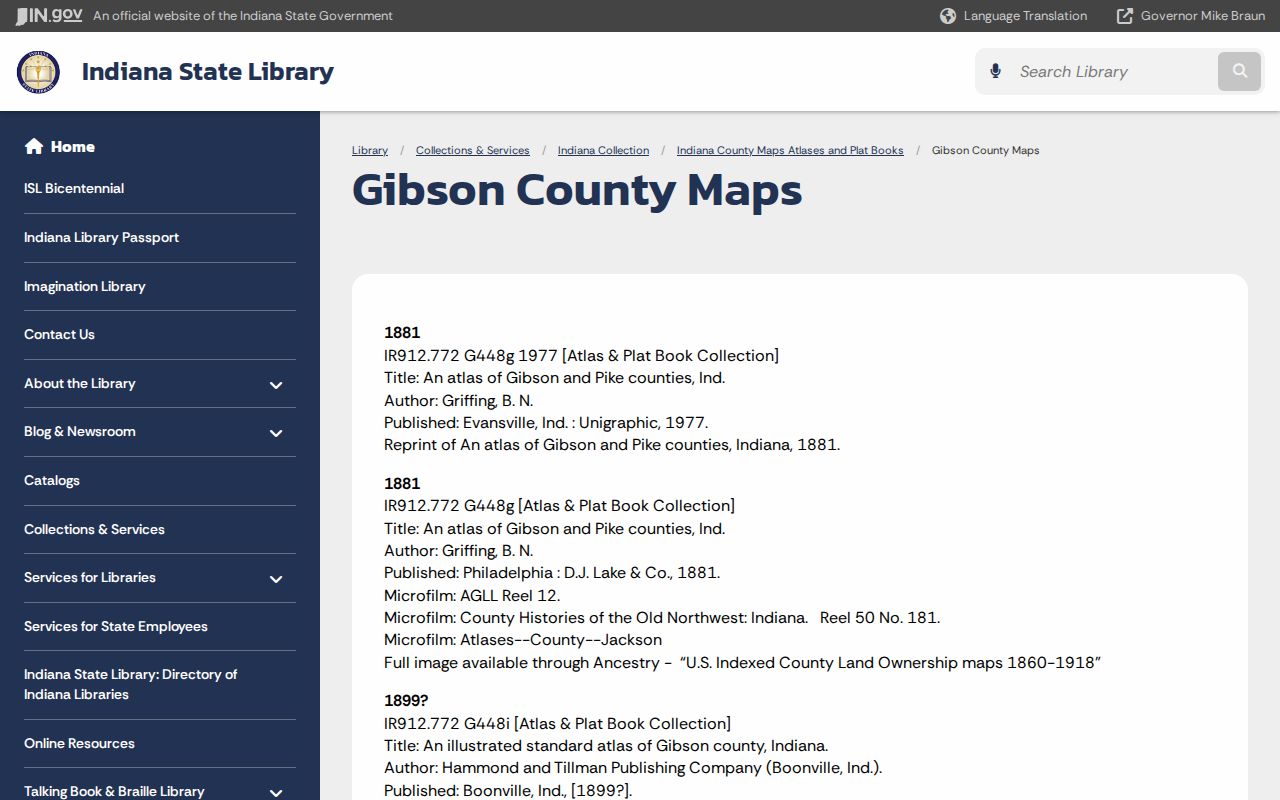
The map bibliography supplies time depth that a current parcel layer cannot show.
Gibson Deed Books Before the Web
Older Gibson County property records have a strong local fallback. Princeton Public Library lists deed books from 1813 through 1885, along with plats, wills, estate indexes, obituaries, and court material. Indiana State Library guides point to microfilm, tract books, county maps, WPA indexes, and land-title sources. FamilySearch extends land-record leads into the nineteenth century, though image access varies.
Keep this older trail separate from the unknown online cutoff. Start with the current deed. Walk backward by grantor and grantee. When the index ends, carry the last verified party, date, book and page, and legal description into the library or courthouse sources. Probate files and obituaries may explain why land passed. Still, only the recorded instrument establishes the recorded transfer. The Princeton Library collection is the most direct local starting point for those volumes.
Princeton's 1814 Plat Lives On
Princeton's plan arose from the Hopkins donation in 1814. Its recorded layout used five ranges of inlots, outlots, and streets sixty feet wide. That history still works. A deed or plat can identify land by the original plan or an addition. It helps when a modern street search fails. South Side Addition, Prince Place Addition, and Baldwin Heights can also tie a legal description to later parcel records. Those names still anchor parcels in Gibson County property records.
Oakland City's 1903 assessor plat for Trusler's Addition builds a different bridge. It shows blocks, in-lots, out-lots, owner names, and values. Fort Branch ordinances document vacated streets and alleys, sometimes with retained utility rights. A current polygon may hide that history. Platted strips carry more paper than any map layer shows.
Gibson Property Fraud Alerts
The Recorder runs a Property Fraud Alert tied to newly recorded documents. Anyone can enroll a personal or business name. A matching instrument then triggers notice. The alert helps when a surprise deed or mortgage appears.
A name match is not proof of fraud. Common names trigger unrelated notices, and the service does not insure title. Compare the document number and legal description with Recorder records. If a filing looks false, keep the notice. Contact the Recorder plus law enforcement or legal help.
Enrollment watches names; the recorded document remains the record.
Gibson Tax and Sheriff Sales
A mortgage foreclosure sheriff sale and a delinquent-tax sale travel different roads in Gibson County. The Sheriff runs court-ordered mortgage sales. They generally land on the third Thursday at 10 a.m. CST unless noted otherwise. The Treasurer and Auditor manage the delinquent-tax side. The Clerk and MyCase carry the related court records. The Recorder, in turn, preserves the deed or lien instrument that formalizes the outcome.
Treat the county's 2024 tax-sale notice as history rather than a live calendar. That notice described an online sale with statutory minimum bids. It also laid out registration steps and a right of redemption. A certificate or listing alone does not prove title passed. Dig deeper before drawing conclusions. Search the parcel, the court case, the tax status, and the later recorded document. The Sheriff's own notice warns that an address, description, taxes, and liens call for independent research. Take that caution seriously when weighing any Gibson County property records on a sale parcel.
Limits of Gibson County Property Records
Gibson County property records can answer a lot. They identify the assessed owner, the recorded grantee, the parcel key, the tax status, the mapped setting, and the instruments sitting in the public index. An estate transfer may surface. So can a recorded easement, a mortgage release, or a historic plat. Still, every source has a ceiling. An assessment is not a sale appraisal. A GIS line is not a legal survey. A MyCase screen is not the official court file, and a deed index hit is not a title opinion.
Indiana APRA, found in Indiana Code 5-14-3, grants inspection and copy rights subject to statutory exceptions. Confidential and protected data may be withheld or redacted under those rules. The Address Confidentiality Program gives eligible survivors substitute addresses. That shield exists for safety, and no searcher should ever try to reverse it.
Lawful use. Gibson County property records support due diligence, boundary research, house history, and civic review. They do not replace a title search or survey, and owner data must never be used to stalk or harass.
For real reliance, order a certified copy from the Recorder or the court. Bring in a qualified title or survey professional when the question demands one. Gibson County property records can be highly useful without settling every legal conclusion.